
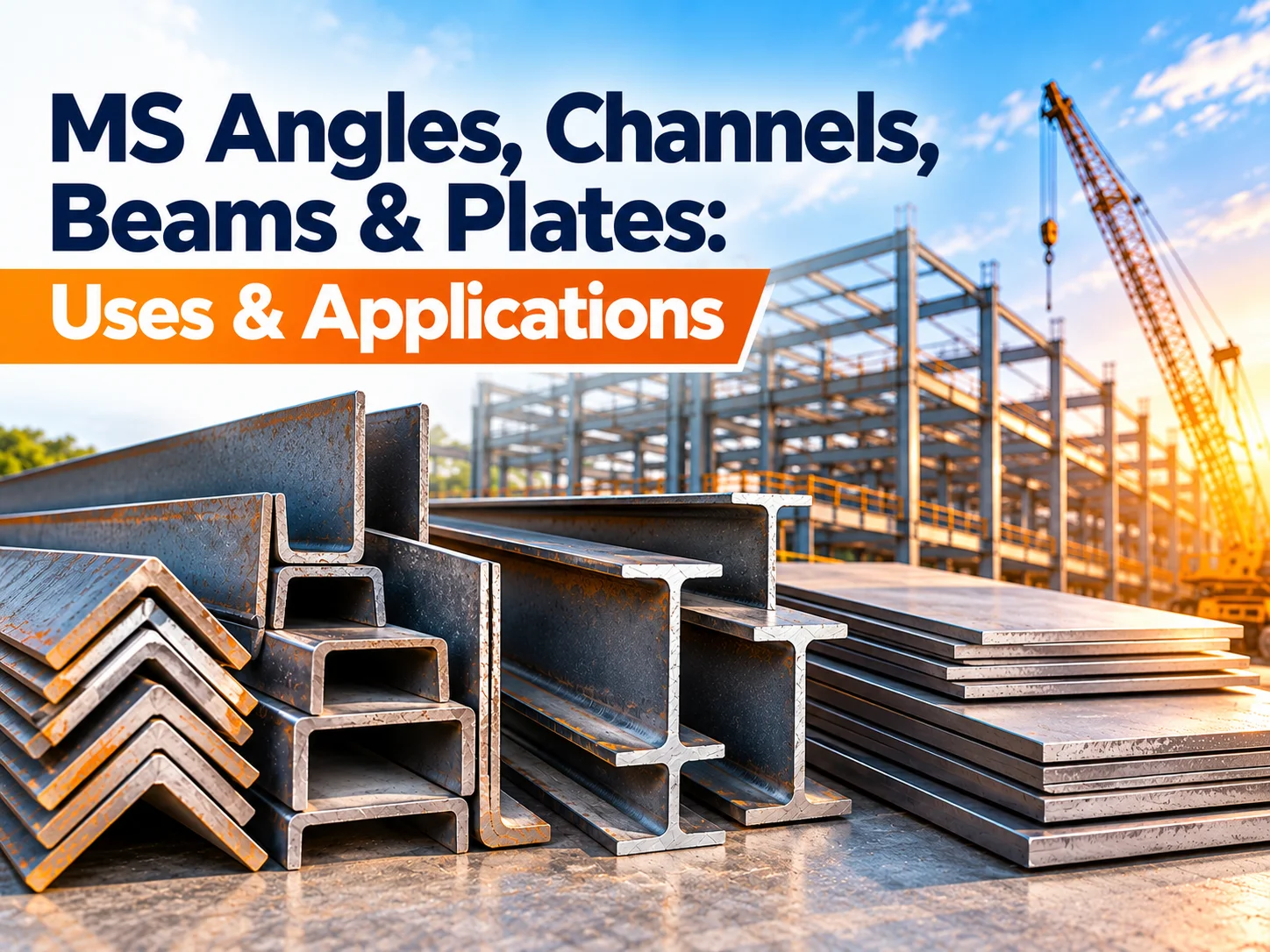
MS Angles, Channels, Beams and Plates: What Are They Used For?
When you look at a steel building, warehouse, industrial shed or fabricated structure, you may notice different steel sections working together. MS angles, channels, beams and plates are among the most commonly used components in structural steel construction.
Although all four products are made from steel, each section has a different shape, strength characteristic and purpose. Therefore, choosing the right section depends on factors such as structural loads, span, connection requirements, fabrication method and project design.
In this guide, we explain what MS angles, channels, beams and plates are, where they are used, how they differ and how to select the right steel section for a project.
What Are MS Angles, Channels, Beams and Plates?
MS stands for mild steel. In construction and fabrication, MS products are available in different shapes and sizes to perform specific structural or engineering functions.
The four common sections include:
MS Angles – L-shaped steel sections used for frames, supports, bracing and fabrication.
MS Channels – C or U-shaped sections commonly used for supports, frames, columns and secondary structural members.
MS Beams – I-shaped or H-shaped sections designed primarily to carry loads across spans.
MS Plates – Flat steel products used for base plates, connections, fabrication and structural components.
Indian standards cover structural steel products and their dimensional requirements. IS 2062 covers structural steel including plates, shapes and sections such as angles, beams and channels. Meanwhile, IS 808:2021 specifies dimensions and sectional properties for hot-rolled beams, columns, channels and angles.
1. MS Angles: What Are They Used For?
MS angles have an L-shaped cross-section. They are available as equal angles, where both legs have the same dimensions, and unequal angles, where the legs have different dimensions.
Because of their simple shape and versatility, angles are widely used in structural and fabrication work.
Common applications of MS angles include:
- Structural bracing
- Frames and supports
- Roof trusses
- Staircase components
- Industrial sheds
- Machinery supports
- Shelving structures
- Equipment frames
- Gates and railings
- Brackets and reinforcement
- Fabricated structures
For example, an angle can connect two structural components while also providing additional stiffness. Similarly, fabricators can use angles to create lightweight frames and support assemblies.
Equal vs Unequal MS Angles
Equal angles have two legs of the same length. They are useful when the load or connection arrangement requires a relatively symmetrical section.
Unequal angles have legs of different lengths. They can be useful when the design requires more surface area on one side or a specific connection arrangement.
The correct angle size should come from the structural design rather than from appearance or material availability alone.
2. MS Channels: What Are They Used For?
MS channels have a C-shaped or U-shaped cross-section. The section consists of a web and two flanges.
Their geometry makes them useful for creating supports, frames and structural members.
Common applications include:
- Industrial shed structures
- Equipment frames
- Staircases
- Vehicle ramps
- Support structures
- Brackets
- Platforms
- Structural framing
- Machine bases
- Purlin and support applications
- Fabricated assemblies
MS channels are also widely used in fabrication because they can be cut, welded and connected to other steel components.
For example, a channel can work as a supporting member in a fabricated frame. In other cases, two channels can work together to form a stronger built-up section.
Namdev Infratech also provides information on MS channels and their applications, making this topic a useful supporting resource for readers who want to understand channel sections in more detail.
3. MS Beams: What Are They Used For?
MS beams are designed primarily to carry loads across a span.
Common structural beam profiles include I-sections and H-sections. Their geometry provides a high level of bending resistance relative to the amount of material used.
As a result, beams are commonly found in:
- Building frames
- Industrial structures
- Warehouses
- Factory buildings
- Mezzanine floors
- Platforms
- Bridges
- Roof structures
- Supporting frameworks
- Heavy fabrication projects
For instance, a beam may support a floor, roof or platform and transfer the load toward columns and other structural members.
Why Are I-Beams Commonly Used?
The I-shaped profile places more material away from the neutral axis. This helps the section resist bending efficiently.
However, the appropriate beam depends on the span, loading conditions, support arrangement, connection details and structural design.
Therefore, a larger beam is not automatically a better beam. Engineers select a suitable section based on calculations and applicable design standards.
Namdev Infratech supplies structural I-beams for construction and industrial applications. Its structural steel range includes beams, channels, angles and plates.
4. MS Plates: What Are They Used For?
Unlike angles, channels and beams, MS plates are flat steel products.
They are available in different thicknesses and dimensions. Depending on the project, plates can be cut, drilled, welded, bent or fabricated into specific components.
Common applications include:
- Base plates
- Connection plates
- Gusset plates
- Structural supports
- Equipment bases
- Machine foundations
- Industrial fabrication
- Tanks and enclosures
- Platforms
- Staircase components
- Heavy-duty frames
- Custom fabricated components
For example, a base plate can distribute the load from a steel column into its supporting foundation. Similarly, a gusset plate can connect structural members at a joint.
MS plates also work well with fabrication processes such as CNC cutting, laser cutting and plasma cutting, depending on thickness, material specification and project requirements.
Namdev Infratech provides HR plate cutting and fabrication services, which can help convert plate material into project-specific components.
MS Angles vs Channels vs Beams vs Plates
The easiest way to understand these products is to compare their typical functions.
| Steel Product | Cross-Section | Primary Function | Common Applications |
|---|---|---|---|
| MS Angle | L-shaped | Bracing and support | Frames, trusses, brackets |
| MS Channel | C / U-shaped | Support and framing | Sheds, platforms, frames |
| MS Beam | I / H-shaped | Load-bearing | Buildings, warehouses, platforms |
| MS Plate | Flat | Connections and fabrication | Base plates, gussets, supports |
However, these applications can overlap.
For example, an angle can form part of a frame, while a channel can also act as a structural support. A plate can connect a beam to another member. Therefore, the final selection should always follow the structural design and fabrication requirements.
How Are These Steel Sections Used Together?
In many construction projects, these products do not work independently.
Instead, they form a connected structural system.
Consider a typical industrial shed.
Beams
Beams can form major load-bearing members of the structure.
↓
Channels
Channels can provide secondary supports and framing.
↓
Angles
Angles can provide bracing, connections and additional support.
↓
Plates
Plates can connect members, distribute loads and create base or connection components.
This combination allows engineers and fabricators to create strong and practical steel structures.
For industrial sheds, Namdev Infratech supplies structural products including I-beams, MS channels, MS angles, plates, flats and other structural sections.
Where Are MS Angles, Channels, Beams and Plates Used?
These steel products support a wide range of construction and industrial applications.
1. Industrial Sheds
Industrial sheds often use multiple structural steel sections.
Beams and columns create the main frame, while channels, angles and plates support secondary framing and connections.
2. Warehouses
Warehouses require large, functional spaces with suitable structural support.
Steel sections can form frames, platforms, mezzanine structures and supporting components.
3. Factory Buildings
Factories often require steel structures for buildings, machinery platforms, walkways and equipment supports.
Therefore, different sections can work together depending on the facility’s layout and loads.
4. Mezzanine Floors
Steel beams can support the main floor structure, while channels, angles and plates can form secondary framing and connections.
5. Staircases and Platforms
Channels and angles can form stair frames and support structures. Plates can create tread supports, connection components and base plates.
6. PEB Structures
Pre-engineered buildings use engineered steel components that are fabricated and assembled according to the project design.
Namdev Infratech works with structural steel requirements for PEB, warehouses, industrial structures and other construction applications.
What Is the Difference Between MS and Structural Steel?
The terms mild steel and structural steel are sometimes used interchangeably in everyday construction conversations. However, they are not always identical terms.
Structural steel refers to steel produced and specified for structural applications. The material must meet the relevant requirements for strength, chemical composition, dimensions and other properties.
For example, IS 2062 covers hot-rolled medium- and high-tensile structural steel, including plates, strips, angles, channels and beams used in structural work.
Therefore, when purchasing steel for a structural project, buyers should check:
- Applicable Indian Standard
- Steel grade
- Dimensions
- Thickness
- Weight
- Tolerances
- Material test certificates
- Surface condition
- Quantity
- Fabrication requirements
What Is IS 2062 and Why Does It Matter?
IS 2062 is an important Indian Standard for hot-rolled structural steel.
It covers structural products such as:
- Plates
- Strips
- Angles
- Channels
- Beams
- Flats
- Bars
- Other structural shapes
The standard applies to structural work and includes material requirements relevant to welded, bolted and riveted structures.
For buyers, this matters because steel selection should not depend only on price or availability. The material should match the project’s engineering specification.
BIS currently lists IS 2062 Part 1:2025 for hot-rolled medium- and high-tensile structural steel, so buyers should verify the applicable current standard and project specification when procuring material.
What Is IS 808?
IS 808:2021 specifies dimensions and properties for hot-rolled steel beam, column, channel and angle sections.
It provides information relating to:
- Section dimensions
- Mass
- Tolerances
- Sectional properties
- Section designation
- Standardized profiles
These details help designers and engineers select sections with predictable geometric and structural properties.
Therefore, when ordering structural sections, it is important to provide the correct section designation and dimensions rather than simply asking for a generic “beam” or “channel.”
How to Choose the Right Steel Section for Your Project
Choosing between an angle, channel, beam or plate depends on the intended function.
Consider the following factors:
1. Load
Determine whether the component will carry compression, tension, bending, shear or a combination of loads.
2. Span
Longer spans often require suitable beam sections based on structural calculations.
3. Connection
Consider whether the component will be welded, bolted or connected using plates and other structural components.
4. Fabrication
The selected section should work with the required cutting, drilling, welding and fabrication processes.
5. Steel Grade
Select the grade according to the structural design and applicable material specification.
6. Environment
Outdoor and industrial environments may require suitable corrosion protection.
7. Quantity and Availability
Standard sizes can simplify procurement and reduce fabrication delays.
8. Project Drawings
Always follow the approved structural drawings and material schedule.
What Should You Check Before Buying MS Steel Sections?
Before placing an order, ask the supplier for clear product and material information.
A practical checklist:
- Product type
- Section designation
- Size
- Thickness
- Length
- Steel grade
- Applicable standard
- Quantity
- Weight
- Mill Test Certificate, where required
- Surface condition
- Delivery schedule
- Cutting or fabrication requirements
A reliable supplier should also help you understand whether the available material matches the project’s specification.
Namdev Infratech highlights structural steel supply for contractors, fabricators, developers and industrial projects in Bangalore, including beams, channels, angles and plates.
Why Quality Matters in Structural Steel
Steel sections form an important part of a building or fabricated structure. Consequently, inconsistent dimensions, incorrect grades or unsuitable material can create problems during fabrication and installation.
Quality steel helps support:
- Consistent fabrication
- Accurate connections
- Better dimensional control
- Predictable structural performance
- Efficient installation
- Reduced rework
However, material quality alone does not guarantee structural safety. The final structure must also follow appropriate engineering design, fabrication procedures, connection details and site practices.
MS Steel Sections for Industrial and Construction Projects in Bangalore
For projects in Bangalore, choosing a supplier that can support both steel procurement and fabrication can simplify project coordination.
Namdev Infratech supplies structural steel products including MS angles, channels, I-beams, plates, flats and other structural sections. The company also provides fabrication-related services for industrial and commercial applications.
This can be useful when a project requires more than standard-length steel. For example, a contractor may need specific cut lengths, fabricated plates, structural assemblies or custom components.
Frequently Asked Questions
What are MS angles used for?
MS angles are commonly used for bracing, frames, supports, trusses, brackets, staircases and fabricated structures.
What are MS channels used for?
MS channels are commonly used for structural supports, frames, platforms, industrial sheds, staircases, equipment supports and fabricated structures.
What are steel beams used for?
Steel beams primarily carry loads across spans. They are widely used in buildings, warehouses, industrial structures, platforms and other load-bearing applications.
What are MS plates used for?
MS plates are used for base plates, connection plates, gusset plates, equipment supports, structural fabrication and other custom steel components.
Which is stronger: an angle, channel or beam?
There is no universal answer. Strength depends on the section size, steel grade, orientation, span, loading condition and structural design. Engineers select the appropriate section based on these factors.
Are MS angles and structural angles the same?
The terminology can vary by application. The important consideration is the material specification, section dimensions, grade and applicable standard rather than the name alone.
What is IS 2062 steel?
IS 2062 specifies requirements for hot-rolled medium- and high-tensile structural steel used in structural work. It covers products including plates, angles, channels, beams, flats and bars.
What is IS 808?
IS 808:2021 specifies dimensions and properties for hot-rolled steel beam, column, channel and angle sections.
Can these steel sections be fabricated?
Yes. Depending on the grade, thickness and project requirements, steel sections can be cut, drilled, welded and fabricated into structural assemblies.
Where can I buy structural steel in Bangalore?
Namdev Infratech supplies structural steel products in Bangalore, including beams, channels, angles, plates, flats and other structural sections.
Conclusion
MS angles, channels, beams and plates each perform a different role in construction and fabrication. Beams primarily carry loads across spans, channels provide structural support and framing, angles work well for bracing and smaller structural members, while plates connect, reinforce and distribute loads.
More importantly, these products often work together to create complete steel structures.
Therefore, selecting the right section requires more than comparing prices. Steel grade, dimensions, structural requirements, applicable standards, fabrication needs and project specifications should all be considered before procurement.
For construction, industrial, warehouse and fabrication projects, working with an experienced structural steel supplier can also simplify material selection, cutting, fabrication and delivery.
Need structural steel for your next project in Bangalore? Talk to Namdev Infratech about your required beams, channels, angles, plates and other structural steel products.