
- Namdev Infratech
- Leave a Comment on TMT vs Structural Steel: How Are Their Prices and Applications Different?
TMT vs Structural Steel: Which One Is Right for Your Construction Project?
Steel is one of the most important materials in modern construction. However, different steel products perform different roles.
Two commonly used categories are TMT steel and structural steel.
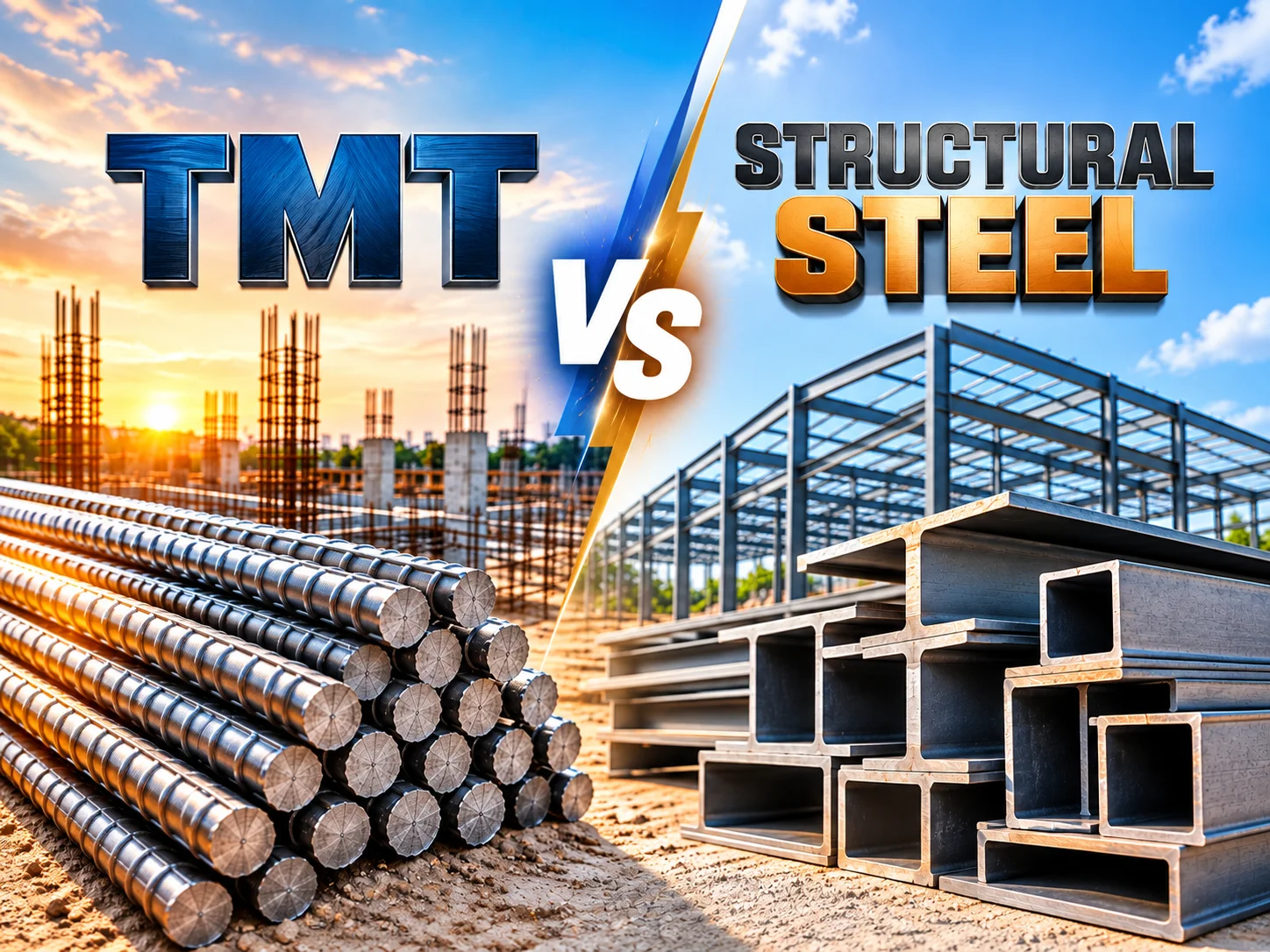
TMT bars primarily reinforce concrete structures. Structural steel, on the other hand, forms load-bearing members such as beams, columns, channels, angles and plates.
So, when you compare TMT vs structural steel, the question is not simply about which one costs less. Instead, you need to consider the project’s structural design, load requirements, construction method, material quantity and overall cost.
In this guide, we explain the difference between TMT and structural steel, their applications, pricing factors, advantages and selection considerations.
If you are looking for dependable steel suppliers in Bangalore, understanding these differences can help you make better procurement decisions.
What Is TMT Steel?
TMT stands for Thermo-Mechanically Treated steel.
Manufacturers produce TMT bars through a controlled thermo-mechanical treatment process. This process creates a strong outer layer while retaining a more ductile core.
TMT bars also have ribs or deformations on their surface. These ribs improve the bond between the reinforcement and concrete.
In India, high-strength deformed steel bars used for concrete reinforcement fall under IS 1786. The standard covers grades such as Fe 415, Fe 500, Fe 500D, Fe 550 and Fe 550D, among others.
Therefore, engineers can select an appropriate TMT grade based on the structural design and project requirements.
Common TMT Bar Applications
TMT reinforcement is widely used in:
- Residential buildings
- Apartment projects
- Commercial buildings
- RCC foundations
- RCC columns
- RCC beams
- RCC slabs
- Footings
- Bridges
- Retaining walls
- Water tanks
- Industrial structures
- Infrastructure projects
For more information about steel products used in construction, you can also explore our guide to MS angles, channels, beams and plates.
What Is Structural Steel?
Structural steel refers to steel products designed for structural applications.
Unlike TMT bars, structural steel usually comes in different shapes and sections. Engineers select these sections according to the loads, span, geometry and structural requirements of a project.
Common structural steel products include:
- I-beams
- H-beams
- MS channels
- MS angles
- MS plates
- Flats
- Hollow sections
- Structural pipes
- Fabricated steel members
If you want to understand the different types of structural sections in greater detail, read our guide to structural steel products and their applications.
Structural steel is widely used in industrial, commercial and infrastructure projects.
Common Structural Steel Applications
Structural steel can be used for:
- Industrial sheds
- Warehouses
- Factory buildings
- Pre-engineered buildings
- Commercial structures
- Bridges
- Platforms
- Staircases
- Steel frames
- Solar structures
- Data centres
- Infrastructure projects
For businesses planning industrial construction, our guide to industrial shed construction in Bangalore can provide additional information about structural steel applications.
TMT vs Structural Steel: Key Differences
The biggest difference between TMT and structural steel is their purpose.
TMT bars mainly reinforce concrete. Structural steel sections create load-bearing frames and members.
| Feature | TMT Steel | Structural Steel |
|---|---|---|
| Primary Purpose | Reinforcing concrete structures | Creating load-bearing structural members |
| Common Form | Ribbed or deformed bars | Beams, channels, angles, plates and other sections |
| Main Application | RCC construction | Steel structures and frames |
| Common Standard | IS 1786 | IS 2062 and other applicable standards |
| Typical Uses | Foundations, columns, beams and slabs | Beams, columns, sheds, warehouses and PEBs |
| Connection | Embedded within concrete | Bolted, welded or mechanically connected |
| Surface | Ribbed or deformed surface | Depends on the steel product and finish |
| Fabrication | Cutting, bending and reinforcement preparation | Cutting, drilling, welding and fabrication are common |
| Typical Project | RCC buildings and concrete structures | Industrial, commercial and steel-framed structures |
| Key Selection Factors | Grade, diameter, weight, ductility and quality | Grade, section, dimensions, weight, loads and application |
This difference is important because TMT and structural steel are not direct substitutes.
In many projects, engineers use both materials togetherHow Are TMT and Structural Steel Prices Different?
Price is one of the first factors buyers consider when selecting steel.
However, there is no universal rule stating that TMT is always cheaper or more expensive than structural steel.
Prices depend on several factors.
For current market considerations, see our detailed guide on steel prices in Bangalore and the factors that influence steel rates.
Factors Affecting TMT Prices
TMT prices can vary according to:
- Grade
- Bar diameter
- Manufacturer
- Order quantity
- Market demand
- Raw material costs
- Transportation
- Location
- Taxes and applicable charges
For example, different TMT grades can command different prices based on their specifications and market availability.
Factors Affecting Structural Steel Prices
Structural steel pricing depends on:
- Steel grade
- Section type
- Thickness
- Dimensions
- Weight per metre
- Quantity
- Manufacturer
- Fabrication requirements
- Surface treatment
- Transportation
- Market conditions
An MS channel, beam, angle and plate can have different prices even when they come from the same supplier.
If you are comparing structural steel products, our resources on [MS beam sizes and applications], [MS channel sizes and applications] and [MS angle sizes and applications] can help you understand how product dimensions affect selection.
Why Price Per Kilogram Is Not Enough
A common mistake during steel procurement is to compare only the price per kilogram.
The purchase price matters, but it does not tell you the complete project cost.
For example, a structural steel project may require:
- Cutting
- Drilling
- Welding
- Fabrication
- Painting or coating
- Transportation
- Erection
- Bolting
- Lifting equipment
An RCC project using TMT reinforcement may involve:
- Reinforcement cutting
- Bar bending
- Binding
- Concrete
- Formwork
- Labour
Therefore, buyers should consider the total installed cost rather than focusing only on the material rate.
This approach can help contractors and project owners make more practical procurement decisions.
TMT vs Structural Steel: Which Is Stronger?
This question sounds simple, but the answer requires context.
TMT and structural steel perform different structural functions.
TMT bars reinforce concrete. Structural steel members carry loads as part of a steel frame or structural system.
For TMT reinforcement, engineers may consider:
- Yield strength
- Tensile strength
- Ductility
- Elongation
- Bend performance
- Bond with concrete
For structural steel, engineers consider:
- Yield strength
- Tensile strength
- Section properties
- Buckling resistance
- Member geometry
- Load-bearing capacity
- Connection design
Therefore, asking which material is “stronger” does not provide a complete answer.
The better question is:
Which material is suitable for the structural requirement?
That distinction helps project teams choose materials based on engineering requirements rather than price alone.
TMT Bars vs Structural Steel Beams
The difference becomes clearer when comparing a TMT bar with a structural steel beam.
TMT Bar
A TMT bar generally works inside concrete.
For example, an RCC column can contain several TMT bars surrounded by concrete. The reinforcement works together with concrete to resist structural forces.
Structural Steel Beam
A structural steel beam forms part of a load-bearing steel frame.
For example, a warehouse may use structural steel columns and beams to create large open spaces.
Engineers can connect these members using bolts, welding or other suitable connection systems.
Therefore:
TMT + Concrete = Reinforced Concrete Structural System
Structural Steel + Connections = Steel Structural System
Both systems have important roles in modern construction.
When Should You Choose TMT Bars?
MT bars are generally suitable when your project uses reinforced concrete construction.
RCC Foundations
TMT reinforcement forms an important part of reinforced concrete foundations and footings.
RCC Columns
TMT bars reinforce concrete columns and help the structural system resist design loads.
RCC Beams
Reinforcement helps RCC beams resist tensile stresses.
RCC Slabs
TMT bars form reinforcement grids within concrete slabs.
Infrastructure Projects
Engineers also use reinforcement steel extensively in bridges, retaining structures and other concrete-based infrastructure.
The required grade, diameter and quantity should always follow the structural design and applicable standards.
For projects that combine RCC and steel framing, explore our content on [steel solutions for construction projects].
When Should You Choose Structural Steel?
Structural steel is particularly useful when a project requires a steel framing system.
Industrial Sheds
Structural steel can provide an efficient framework for factories, workshops and industrial facilities.
Learn more about industrial shed manufacturers and steel construction in Bangalore.
Warehouses
Steel framing can support large open spaces and long spans, making it suitable for many warehouse designs.
You can also read our guide to structural steel for warehouse construction.
Pre-Engineered Buildings
PEB systems commonly use engineered structural steel members for primary and secondary framing.
If you are comparing construction methods, see PEB vs conventional construction.
Commercial Structures
Structural steel can support commercial buildings, platforms, staircases and other engineered structures.
Solar Structures
Steel sections can form support structures for solar installations when designed according to project requirements.
Read more about structural steel for solar projects.
Data Centres
Data centres can require fast construction, large structural spans and carefully engineered building systems.
Our article on structural steel for data centre construction provides more information about this application.
Can TMT and Structural Steel Be Used Together?
Yes.
In fact, many construction projects use both materials.
Consider a typical industrial building:
Foundation → RCC + TMT reinforcement
↓
Pedestal → RCC + TMT reinforcement
↓
Columns → Structural steel
↓
Beams → Structural steel
↓
Roof system → Structural steel
This combination allows engineers to use each material where it performs best.
Therefore, the choice is not always TMT vs structural steel.
In many projects, the better approach is:
TMT where concrete requires reinforcement + structural steel where the project requires steel framing.
TMT vs Structural Steel for Industrial Buildings
Industrial buildings often have different requirements from conventional residential construction.
A typical industrial facility may require:
- Long clear spans
- Large openings
- High roof loads
- Equipment loads
- Crane loads
- Fast installation
- Future expansion
- Efficient use of floor space
Structural steel can address these requirements through engineered beams, columns, trusses, purlins and other members.
However, TMT reinforcement still plays an important role when the project includes RCC foundations, floors, pedestals or other concrete elements.
As a result, industrial projects often use both TMT and structural steel.
For a broader understanding of industrial steel applications, read how structural steel supports modern industrial construction.
TMT vs Structural Steel for Residential Buildings
Residential construction often relies heavily on RCC.
A typical residential building may use TMT reinforcement in:
- Footings
- Columns
- Beams
- Slabs
- Staircases
- Retaining walls
Structural steel can also appear in residential projects for:
- Staircases
- Roof structures
- Canopies
- Long-span members
- Architectural features
- Special structural requirements
Therefore, the choice depends on the architectural and structural design.
TMT vs Structural Steel: Which Is More Cost-Effective?
The answer depends on the project.
For a conventional RCC building, TMT reinforcement forms an essential component of the concrete structure.
For a warehouse or industrial shed, a structural steel frame can offer advantages such as fast erection and long-span construction.
However, project economics depend on more than the steel purchase price.
Consider:
- Material quantity
- Steel grade
- Structural design
- Fabrication
- Labour
- Transportation
- Erection
- Concrete requirements
- Formwork
- Construction duration
- Maintenance
- Future expansion
The key takeaway
The lowest steel price does not always produce the lowest project cost.
Instead, select the material that meets the engineering requirements while providing an efficient overall project solution.
For additional procurement guidance, read how to choose a reliable steel supplier in Bangalore.
How to Choose the Right Steel Supplier
Choosing the right supplier becomes especially important for large construction projects.
Whether you need reinforcement steel or structural steel, consider the following factors.
1. Product Standards
Confirm that the material meets the applicable Indian Standard and project specifications.
2. Material Quality
Ask for relevant test certificates and product documentation where required.
3. Grade Availability
Make sure the supplier can provide the required grade and dimensions consistently.
4. Stock Availability
Large projects often require scheduled deliveries. Reliable stock planning can help prevent construction delays.
5. Quantity Accuracy
Check quantities against purchase orders, delivery documents and project requirements.
6. Delivery Capability
Transportation becomes particularly important for large structural sections and bulk steel orders.
7. Product Range
A supplier with a broad product range can make procurement easier when your project requires multiple steel sections.
Explore our range of structural steel products for construction and industrial applications.
8. Industry Experience
Experience with construction and industrial projects can help a supplier understand practical procurement requirements.
TMT vs Structural Steel: Quick Decision Guide
| Project Requirement | Choose TMT Steel | Choose Structural Steel |
|---|---|---|
| RCC Building | ✓ Ideal for reinforcing concrete | Usually not the primary reinforcement material |
| Columns & Slabs | ✓ Used as reinforcement with concrete | Can be used where a steel-framed design is specified |
| Steel Building Frame | Not normally used as the main framing material | ✓ Ideal for beams, columns and structural frames |
| Industrial Shed | May be used in the concrete foundation | ✓ Suitable for structural frames, columns and beams |
| Warehouse / PEB | Primarily used in RCC foundations and other concrete elements | ✓ Suitable for structural framing and load-bearing members |
| Load-Bearing Steel Members | ✗ Not the usual choice | ✓ Designed for beams, columns, channels, angles and plates |
| Best Selection Factors | Grade, diameter, ductility, weight and concrete design | Grade, section size, thickness, loads, fabrication and application |
| Can Both Be Used Together? | ✓ Yes, especially in RCC and composite construction | ✓ Yes, depending on the structural design |
Always select the final material, grade, section and quantity according to the structural design and applicable specifications.
TMT vs Structural Steel: Frequently Asked Questions
Is TMT steel the same as structural steel?
No. TMT bars primarily reinforce concrete, while structural steel products such as beams, channels, angles and plates form structural members and steel frames.
Which is cheaper, TMT or structural steel?
Neither material has a universally lower price. Rates depend on grade, dimensions, quantity, market conditions, supplier and project requirements.
Can TMT bars replace structural steel beams?
TMT bars are primarily designed for concrete reinforcement. They should not replace engineered structural steel beams unless a qualified engineer specifically designs the member for the intended application.
What is the main standard for TMT bars in India?
IS 1786 covers high-strength deformed steel bars for concrete reinforcement.
What is the main standard for structural steel?
IS 2062 covers hot-rolled medium and high-tensile structural steel. Other structural steel products can also fall under additional applicable Indian Standards.
Can a project use both TMT and structural steel?
Yes. Many projects use TMT reinforcement in RCC foundations, slabs and other concrete elements while using structural steel for beams, columns, frames and other steel members.
Which is better for an industrial shed?
Structural steel is commonly suitable for industrial shed framing because it can provide engineered long-span members and efficient fabrication and erection. The final selection should always follow the structural design.
Does structural steel cost more than TMT?
Not necessarily. The final cost depends on grade, quantity, section type, fabrication, transportation, erection and the overall construction system.
How can I reduce steel procurement costs?
Start with an accurate material requirement, compare suitable grades and sections, consolidate bulk purchases where practical and work with a supplier that can provide reliable quality and delivery.
Final Takeaway: TMT vs Structural Steel
TMT and structural steel have different but equally important roles in construction.
TMT bars primarily reinforce concrete structures, while structural steel creates load-bearing members such as beams, columns, channels, angles and plates.
Therefore, choosing between them should not come down to price alone.
Instead, consider:
Application + Structural Design + Grade + Quantity + Fabrication + Installation + Total Project Cost
When you match the right steel product to the right application, you can improve structural efficiency, control procurement costs and support smoother construction.
For projects in Bangalore and across Karnataka, an experienced structural steel supplier in Bangalore can help you source suitable products for construction, industrial and infrastructure applications.
Need Structural Steel for Your Project?
Namdev Infratech supplies structural steel products for construction and industrial applications.
From beams, channels, angles and plates to other structural steel sections, we support project-based and bulk steel requirements.
Whether you are planning an industrial shed, warehouse, PEB, commercial structure, solar project or other steel construction project, connect with Namdev Infratech to discuss your requirements.
Talk to Namdev Infratech
Looking for reliable steel supply for your next project?
Contact Namdev Infratech for structural steel requirements, bulk procurement and project-based supply.